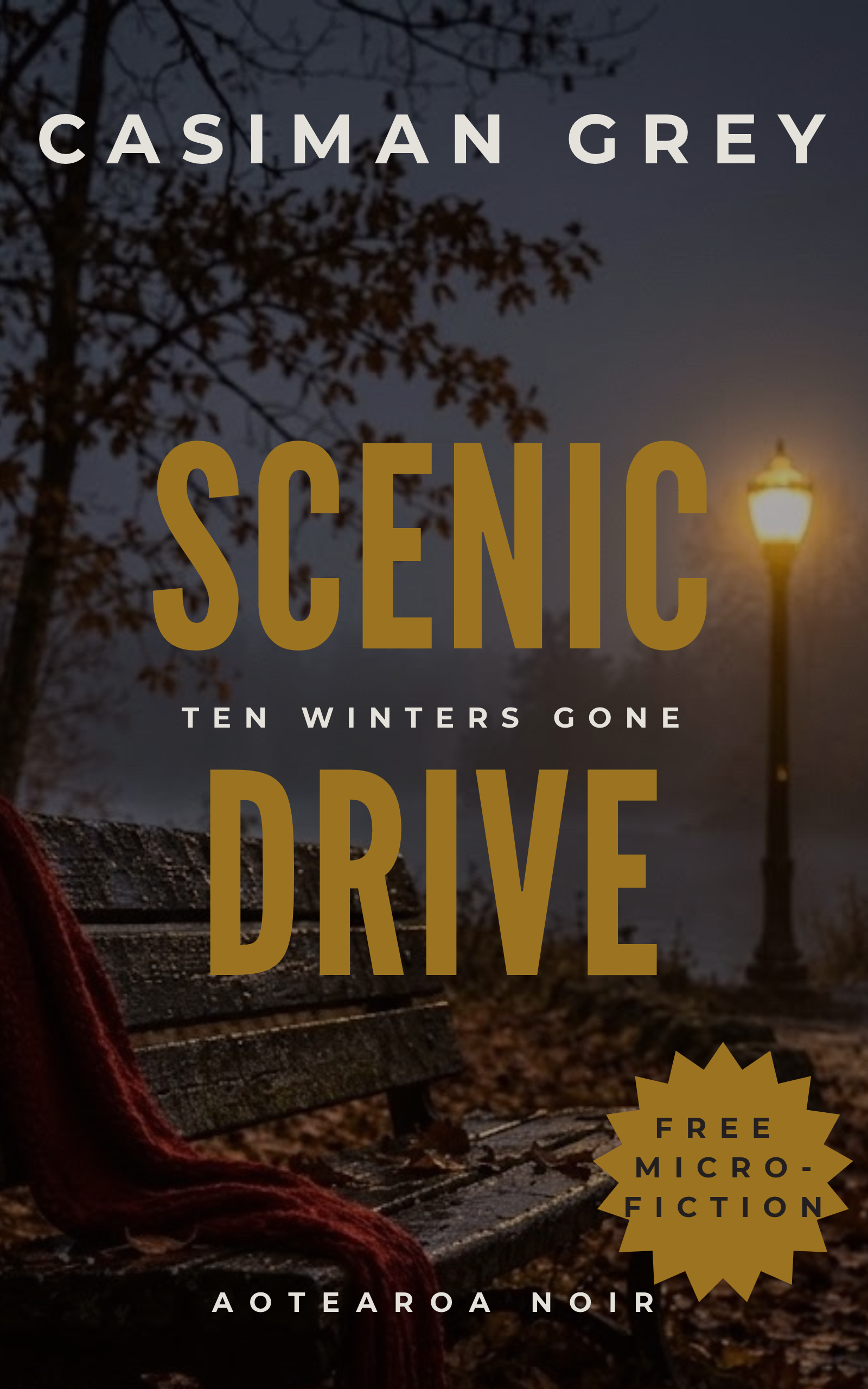
‘Scenic Drive’
Western Springs. Six in the morning.
The mist rolls off the lake like cold grey smoke, choking out the trees and deadening the sky. Up on the Northwestern, it’s still too early for the commuter crawl. Just the occasional refrigerated diesel truck barrelling west, a flat rumble that dies the second it hits the fog.
Down here, there is only the rot. Wet earth, saturated ground, sodden autumn leaves pasted across the dark timber of a park bench.
And between them, the wool.
A jagged slash of scarlet coiled against the wet slats. Fresh blood on dirty timber.
Neither man moves. Collars pulled high against the bite of the wind. Staring at what should have stayed buried six feet under the fern roots.
Robert’s stomach burns. The sour wash of stomach acid and three crushed antacids. Back in Grey Lynn, his wife is still asleep beneath Belgian linen. Warm. Safe. Blissfully ignorant of the monster sharing her bed.
‘Why did you bring it here?’ Robert’s voice is low, scraped raw.
‘You think I want to look at it?’
‘It was supposed to stay in the bush, Cam. We made a pact.’
‘Pacts don’t pound out a crumpled fender, Rob.’
‘Damn it, Cam.’ Robert’s hands are shaking inside his tailored overcoat. ‘How much? Just name a figure. You crawled into the culvert and dragged it out. Fine. What makes it disappear?’
‘You think this is about money?’
‘Everything’s about money.’
‘That what your soul trades in these days?’
‘Don’t play the martyr. Not after Scenic Drive.’ The memories detonate behind Robert’s eyes.
Ten winters ago. Rain slamming down sideways through the kauri trees. An old Subaru Legacy with bad wipers and worn pads. The smell of cheap gin on their breath.
Then the thump.
Not loud. Just a wet, heavy sack hitting the front-left quarter-panel. The girl on the bike. An amber indicator housing shattering across the tarmac like orange teeth.
‘I didn’t touch the scarf,’ Campbell says, voice dead as river stone. ‘You did.’
‘Bullshit.’ Paranoia clamps Robert’s throat like a vice. ‘I stood there while the radiator hissed in the dark, watching you shove her bike down the gully. You stuffed that wool under the ponga roots with your bare hands. You swore we would be clean and clear.’
‘And you believed that?’ Campbell doesn’t turn his head. He just stares straight into the fog, unblinking, eyes washed out. ‘You really thought time could scrub out the sound? That crunch of bone against chassis?’
‘Stop.’
‘The way her sneaker stayed in the road when she went over the bank?’
‘Shut up, Cam!’ Robert leans in, teeth bared, ready to smash Campbell’s face into the wood. ‘Look at me! Why the hell did you dig it up?’
Campbell doesn’t flinch.
‘You know why,’ Campbell whispers. ‘Because you never drove away, Rob. You’ve been kneeling in that wet clay beside her for ten years. Waiting for the cuffs.’
‘I have a life! A marriage! I moved on!’
‘You sure?’
A crunch cuts through the trees.
Footsteps. Wet gravel.
A runner comes out of the grey soup—fluorescent windbreaker, breath pluming in the freeze. He glances at the bench. Gives the quick, uneasy Kiwi nod.
‘Bit chilly to be sitting out here by yourself, mate,’ he calls, picking up his pace.
The sound fades. Gone.
Robert turns.
The bench is empty.
The wet leaves beside him are flat, rotting, undisturbed.
Memory floods in.
Campbell didn’t bring the scarf. Campbell didn’t say a word. Campbell hanged himself five years ago in an Avondale garage with an extension cord, his neck broken under the weight of the secret.
Robert sits alone in the cold.
The scarlet scarf is still there, reeking of sour ditch clay and stagnant run-off.
Robert looks down at his hands.
Under every fingernail, the dirt is fresh, black, and wet.